Twilight transition
The value of this stop is the timing: arriving in the last light, when the palace-hotel exterior, lit windows, gardens, and forest edge all feel more atmospheric than informational.
Luso / Evening Palace Stop
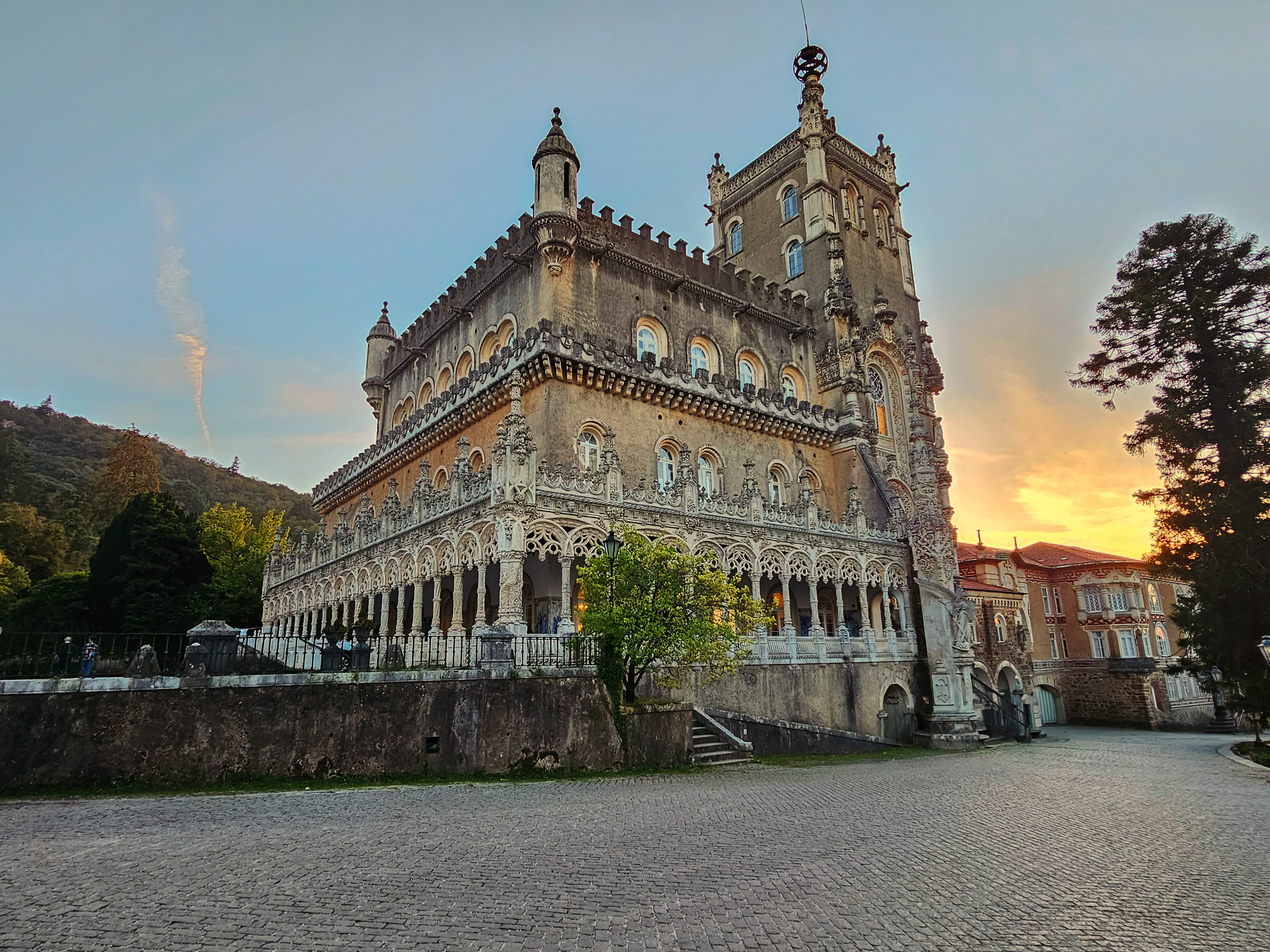
Bussaco gives Day 2 its evening turn: an ornate palace-hotel in the Buçaco forest setting, blue azulejo corridors, formal gardens, and the feeling of arriving somewhere grand just as the light starts to leave.
Bussaco changed the temperature of the day. After the density of Regaleira and Tomar, the palace-hotel, azulejo corridor, gardens, and dusk light felt like a slower arrival rather than another hard sightseeing push.
This was its own Luso/Buçaco moment before Coimbra: ornate facade first, then tile, garden geometry, forest edge, and the last usable light.
The stop let the day exhale without becoming vague. It was still beautiful and specific, just softer than the major architecture stops that came before it.
After Regaleira, Almourol, and Tomar, Bussaco changes the day from touring to evening atmosphere.
The value of this stop is the timing: arriving in the last light, when the palace-hotel exterior, lit windows, gardens, and forest edge all feel more atmospheric than informational.
The palace-hotel is widely described as Neo-Manueline and belongs to the Buçaco forest setting, with the older Carmelite convent landscape still part of the place's identity.
The stop naturally breaks into three beats: the facade, the azulejo corridor, and the gardens/grounds before continuing to Coimbra.
Facade, azulejos, gardens, and a few edge details before the route finishes in Coimbra.
The first exterior frames carry the mood: an ornate Neo-Manueline palace-hotel at dusk, warm windows, elaborate stonework, and the sense that the day has shifted from sightseeing to evening atmosphere.
The blue tile panels and covered corridor deserve their own pause. They are the visual bridge between the palace-hotel fantasy outside and the historical storytelling inside the building, and they slow the stop down in the best way.
The garden frames are the calmest part of Bussaco: clipped hedges, a central fountain, paths, and the last soft light over the grounds. After a dense day, this is the breathing space before Coimbra.
A few details keep Bussaco from becoming only a facade: stairs, sculpture, benches, and side paths at the edge of the building. They work as supporting texture, not a separate grand claim.
The full set shows the stop as it felt: ornate facade, tile corridor, garden paths, dusk light, and the final exterior frames before dinner.