Follow the layers
The stop moves from corridors and azulejos into the Charola, then out through carved stone, cloisters, exterior spaces, and quieter rooms. Treat it as a sequence rather than a checklist.
Tomar / Convent of Christ
Tomar is where Day 2 turns architectural: the Convent of Christ gathers tiled corridors, sacred interiors, carved stone, cloister geometry, and Portugal's Templar-to-Order-of-Christ story into one layered complex.
The Convento de Cristo did not feel like one monument with one payoff. It unfolded through tile corridors, sacred interior space, carved stone, cloisters, outer rooms, and quieter spaces near the end.
The history is real and heavy: Templar origins, the Order of Christ, and centuries of architectural layering. But the visitor experience is physical before it is academic.
What stayed with me was the pace of moving through it: blue-and-white corridors into the Charola, dense ornament into open cloister light, then rougher outer stone before the route turned north again.
Tomar is strongest when the spaces are allowed to build on each other.
The stop moves from corridors and azulejos into the Charola, then out through carved stone, cloisters, exterior spaces, and quieter rooms. Treat it as a sequence rather than a checklist.
UNESCO identifies the complex with the Knights Templar of Tomar and its later transfer to the Order of Christ. That history matters, but the visitor experience is still physical: rooms, light, stone, tile, and thresholds.
The complex carries Romanesque, Gothic, Manueline, Renaissance, Mannerist, and Baroque layers. Use those terms as orientation, not as a reason to bury the reader in labels.
Each section changes the scale: corridor, sacred center, detail, cloister, exterior layers, carved close-up, and final quiet room.
Blue tile panels, long corridors, arches, and small courtyards set the rhythm before the famous interiors arrive. Tomar feels like a sequence of thresholds, and this is where that begins.
The Charola asks for a slower pace. UNESCO identifies the 12th-century Templar rotunda as the centerpiece of the complex, and the space feels different here: vertical, hushed, dense with sacred ornament, and less interested in quick movement.
The carved knots, ribs, windows, and small architectural details connect the sacred interior to the open cloister. They are small on their own, but together they make the complex feel layered rather than merely old.
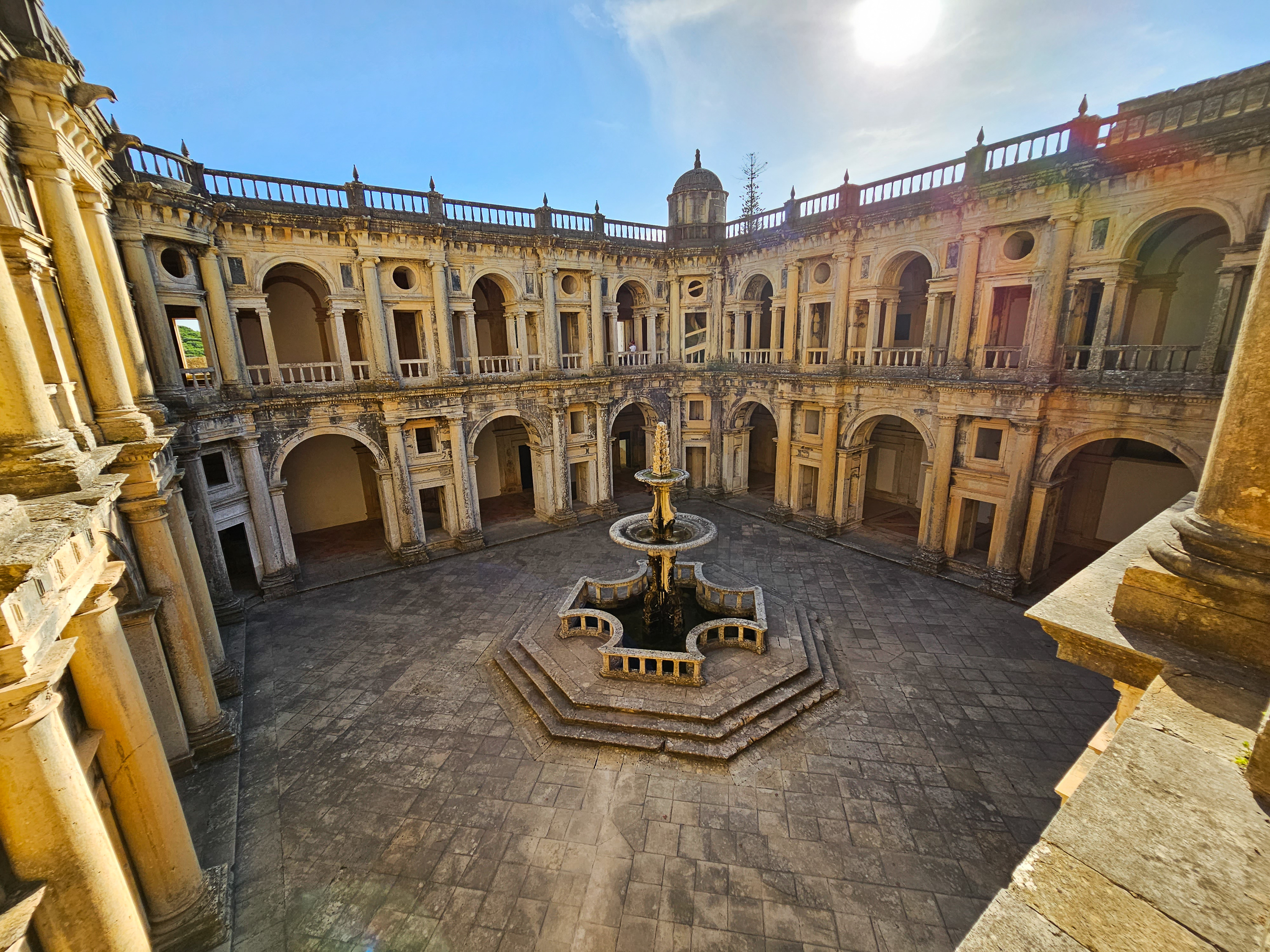
The main cloister is the visual reset: repeated arches, sunlit walls, a central fountain, and enough open space to breathe after the tighter interior rooms. This is the point where Tomar becomes grand without needing to shout.
After the main cloister, the route opens into roofless rooms, exterior church views, and stone passages. It feels less like arriving at one more famous object and more like wandering the outer layers of a complex that has kept being adapted over centuries.
The final carved-stone details deserve their own pause because they are dense and easy to rush past. UNESCO calls out the Manueline exterior bays, window, and oculus as a major expression of the style, so the reward is in looking closely while still keeping the surrounding architecture in view.
The last room is quieter: vaulted, functional, and calmer than the cloisters. It works as a closing breath after an hour of tile, sacred interiors, open courtyards, and carved stone.
The slideshow is the best way to feel the pacing of the stop: thresholds first, then sacred center, cloisters, outer stone, and detail.